
Changes to Building Washing Agrichemical Classifications
CAA recently confirmed that for building washing with drones they are now applying the definition of agrichemicals applied by the Environmental Protection Authority (EPA). This means that if the EPA classifies the chemical as a cleaning chemical then some of the requirements for aerial spraying, aerial topdressing, and aerial VTA no longer apply.
You can find the group standards for cleaning chemicals here. Check the Safety Data Sheet for the chemical you intend to apply–if it has the HSR number for one of the cleaning chemical group standards (such as HSR002526) then it is classified as a cleaning chemical.
Examples of what to look for:
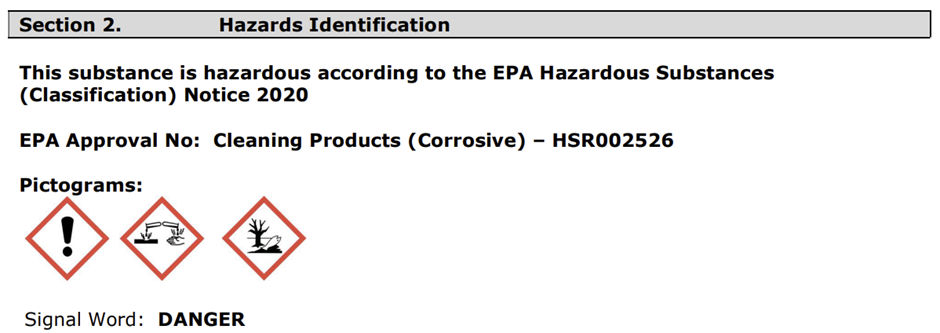

If the chemical is a cleaning chemical, then you will no longer need to obtain a pilot chemical rating or a UAV agricultural rating.
You will still need to obtain Part 102 certification if any of the following apply:
- The gross mass of the drone – including the spraying equipment, length of hose lifted, and water in the hose – is greater than 25kg for at least part of the operation.
- Sometimes you intend to apply a chemical that is classed by the EPA as an agrichemical.
- You want to utilise another Part 102 privilege such as notification and engagement with an aerodrome operator rather than gaining their responsibility.
Note that this does not absolve you of responsibility for chemical trespass. If the chemical you are applying ends up on another property – for any reason – then you will potentially be liable for any damage caused. Even common non-caustic cleaners can cause spot burns on vegetation.
Many cleaning chemicals will be hazardous in a concentrated form (e.g. corrosive), and all relevant hazardous substances regulations must be complied with.
November 2025